
URGENT VETERINARY WARNING
Is your girl showing signs of eclampsia right now?
If your dog has recently had puppies and is panting heavily, pacing, trembling, walking stiffly, unable to settle or behaving unusually, this is not the time to compare supplements.
Stop the puppies from feeding and contact your vet immediately.
Oral calcium supplements, cheese, yoghurt, goat's milk and home remedies do not replace emergency veterinary treatment.
You may be preparing for one carefully planned litter from your much-loved family dog without ever really thinking of yourself as a "breeder".
Then suddenly, you find yourself surrounded by advice about calcium.
"Start it during pregnancy." "Wait until labour." "Give cheese." "Use liquid calcium." "She’s on a complete food, so she won’t need anything extra."
Confused yet?
The problem is that calcium advice is often shared as though every dog, diet, litter and stage of reproduction is exactly the same. They are not.
Calcium is essential during labour and lactation, but more calcium is not automatically safer. When it is given, how much is used and which formulation you choose all matter.
Does calcium prevent eclampsia in dogs? The quick answer
No calcium supplement can guarantee that eclampsia will not occur.
Routine calcium supplementation during pregnancy may interfere with the body’s natural calcium-regulating system and increase susceptibility to hypocalcaemia after whelping.
Once labour and lactation begin, the situation changes. Some dogs may benefit from a carefully planned post-whelp calcium supplement, depending on:
- Their complete diet
- How much food they are actually eating
- Their breed and body weight
- Litter size and milk demand
- Previous pregnancies or eclampsia
- Other supplements and calcium sources
Calcium is therefore best viewed as one part of a complete post-whelp plan, not a magic insurance policy.
Why does calcium matter so much after whelping?
Calcium is needed for:
- Normal nerve signalling
- Muscle contraction
- Heart function
- Normal labour contractions
- Milk production
- Maintaining normal blood calcium levels
During lactation, calcium is transferred from your girl’s bloodstream into her milk. As her puppies grow and drink more, milk production rises. Her body must continually replace the calcium being lost into that milk by absorbing calcium from food and mobilising calcium stored within her body.
If demand begins to exceed what her body can provide, her blood calcium can fall dangerously low. This is what can lead to eclampsia, also known as milk fever or lactational hypocalcaemia.
Pregnancy is not the time to throw calcium at the problem
It feels logical to assume that if low calcium causes eclampsia, feeding additional calcium throughout pregnancy must help prevent it. Unfortunately, the body is more complicated than that.
During pregnancy, your girl’s calcium-regulating system is preparing for the sudden demands of milk production. Her body needs to remain responsive to hormones that help it absorb calcium from food, mobilise stored calcium, and maintain calcium within the bloodstream.
Giving unnecessarily high levels of calcium during pregnancy can reduce the stimulation of this system. Then, once the puppies arrive and milk demand rises rapidly, her body may be less prepared to respond.
This is why routine additional calcium during pregnancy may increase susceptibility to eclampsia rather than reduce it.
Do not begin calcium supplementation during pregnancy unless your vet has identified a specific medical or dietary reason.
A calcium supplement should also never be used to patch over an unbalanced pregnancy diet. If you are feeding a home-prepared or raw diet, the entire recipe needs assessing rather than simply adding extra calcium and hoping for the best.
Once labour begins, the rules change
Once labour begins, calcium is involved in muscular contractions. After the puppies arrive, calcium demand continues to rise as milk production becomes established.
This is the stage when a properly considered calcium plan may have a place. That does not mean blindly giving the same amount to every dog. A 5kg toy breed feeding six puppies does not have the same needs as a 35kg dog feeding four.
A dog eating plenty of a complete reproduction diet is also in a different position from a dog who has stopped eating properly, is losing condition, is feeding a particularly demanding litter, eats a home-prepared diet, or has previously experienced eclampsia.
This is why the plan should reflect the dog in front of you.
Does every nursing dog need extra calcium?
Not necessarily. A complete commercial diet intended for reproduction, growth or lactation should already provide calcium and phosphorus in an appropriate balance when fed in sufficient quantities.
A correctly formulated raw or home-prepared diet should also account for calcium, phosphorus and the increased demands of lactation.
The key phrase is when fed in sufficient quantities. A food can be beautifully balanced on paper, but if your girl is only eating half of what she needs, she is only receiving half of the nutrients that food was designed to provide.
Whether additional calcium is appropriate therefore depends on the whole picture: what she eats, how much she eats, her weight and condition, her litter and milk production, her previous history and total calcium intake.
Don’t stare at the calcium tub and forget the bowl
Calcium is only one part of her post-whelp nutrition. A nursing dog also needs enough energy, protein, fat, water, vitamins and minerals. Her energy needs can rise significantly as milk production increases.
If she is not eating enough, is becoming fussy, has diarrhoea, is vomiting or is losing weight rapidly, simply increasing calcium will not solve the wider problem.
You should also monitor: her appetite and water intake, body condition, behaviour and movement, ability to rest, puppy weights, and how frequently the puppies are feeding.
Not all calcium is created equally
Calcium is supplied in different forms, including calcium citrate, calcium gluconate, calcium carbonate, calcium lactate, and calcium chloride. Each form contains a different proportion of elemental calcium, meaning the amount of actual calcium available within the compound.
This means one capsule is not automatically equal to another capsule, and different products cannot be swapped dose-for-dose.
How to choose the right calcium supplement after whelping →
Have you ever put two calcium supplement labels side by side and wondered why their numbers look so different? This is where things get interesting. The weight of a calcium compound is not the same thing as the amount of elemental calcium it provides. Calcium citrate and calcium gluconate supply different proportions of elemental calcium, so you cannot swap a capsule for a scoop, or one product for another, simply because their packaging uses similar figures.
- Check the amount of elemental calcium actually supplied, not just the compound weight.
- Check how precisely the product can be measured for your girl.
- Consider how well she is eating and what calcium her complete diet already supplies.
- Check for overlapping ingredients in any other supplements you're using.
One of the reasons I offer both capsules and powder is that the most practical format for a small bitch taking food happily may be completely different from what works for a larger, fussy nursing girl. Read my full WHELP WISE versus CALCI-POWER comparison.
And what else is hiding in that bottle?
Some products also contain sugars or glucose syrups, artificial flavourings, preservatives, colourings, propylene glycol, added vitamins, or additional minerals. E-numbers and sugars will not help milk production.
Choose the formulation, not the loudest marketing claim.
That doesn't mean every E-number is a danger sign. It does mean it's worth understanding what the extra ingredients are doing, particularly when you're feeding the product repeatedly. Added vitamins and minerals can overlap with the rest of her diet, while sweeteners, flavourings and fillers may serve no useful purpose for the job you're trying to achieve. It's the full formulation that matters, not the loudest marketing promise on the label.
My 3D Rule of Supplements
Whenever I assess a supplement, I use my 3D Rule:
- Dose — Is she receiving an appropriate amount for her weight, diet, litter, history and current demand? Too little may not provide meaningful support. Too much is not automatically better.
- Duration — Is it being used at the correct stage? Calcium during pregnancy is not the same as calcium during labour and lactation. A suitable product used at the wrong time is still the wrong plan.
- Design — What has the supplement actually been designed to provide? Look at the calcium compound, elemental calcium, format, additional ingredients, ease of feeding, tummy tolerance and how accurately it can be measured.
Which CNC calcium supplement should you choose?
We offer two different calcium formats because one product will never suit every girl or every owner.
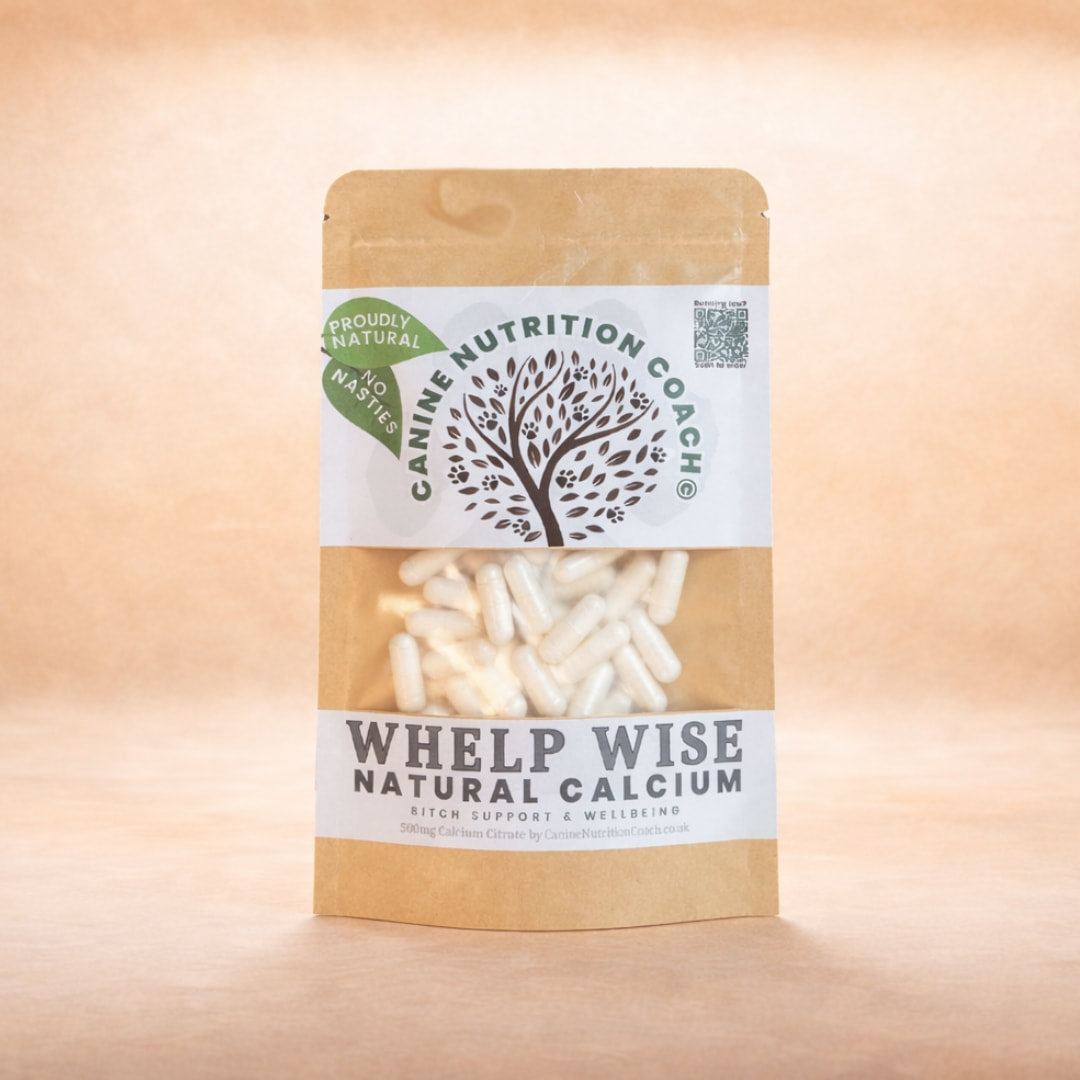
CNC WHELP WISE Natural Calcium
CNC WHELP WISE contains calcium citrate in individually measured capsules. It may suit small and medium dogs, owners who prefer measured capsules, and people wanting a neat, portable format.
CNC CALCI-POWER
CNC CALCI-POWER contains calcium gluconate in a dissolvable powder. It may suit larger dogs, fussy eaters, dogs who refuse capsules, and owners managing larger quantities.
Both products are designed for labour and post-whelp nutritional support, not routine supplementation during pregnancy. Neither product is an emergency treatment for a dog showing symptoms of eclampsia.
The big takeaway
Calcium can form an important part of your girl’s labour and post-whelp nutrition plan, but it cannot guarantee that eclampsia will never happen. The safest approach is to:
- Avoid routine additional calcium during pregnancy
- Review the complete diet
- Make sure she is eating enough
- Account for every calcium source
- Choose an appropriate calcium formulation
- Use it at the right stage
- Monitor your girl throughout lactation
- Learn the early signs of eclampsia
Good planning reduces avoidable mistakes. Awareness means you are more likely to recognise when she needs veterinary help.
Products mentioned in this guide
The choice isn't about which calcium product has the biggest number on the front. It's about the dog in front of you, the amount of elemental calcium, the stage of lactation, how she eats and how precisely the amount can be measured.

CNC WHELP WISE
Measured calcium citrate capsules, convenient when accuracy and portability matter. View WHELP WISE.

CNC CALCI-POWER
Dissolvable calcium gluconate powder, useful when a flexible feeding format is easier. View CALCI-POWER.
Veterinary and scientific sources
- MSD Veterinary Manual: Eclampsia in Small Animals.
- VCA Animal Hospitals: Eclampsia in Dogs.
- Fontaine E. Food Intake and Nutrition During Pregnancy, Lactation and Weaning in the Dam and Offspring.
- Drobatz KJ and Casey KK. Eclampsia in Dogs: 31 Cases, 1995–1998.
Would you like help tailoring her post-whelp plan?
If your dog is currently displaying possible symptoms of eclampsia, stop the puppies from feeding and contact your vet immediately.
If you are preparing for puppies and want help reviewing your girl’s diet, post-whelp feeding and calcium supplementation, you can book a one-to-one coaching call with Isobel.
Looking for support throughout pregnancy, whelping and puppy rearing? Explore coaching and breeding support options →
Veterinary and scientific sources: MSD Veterinary Manual: Eclampsia in Small Animals • VCA Animal Hospitals: Eclampsia in Dogs • Fontaine E. Food Intake and Nutrition During Pregnancy, Lactation and Weaning in the Dam and Offspring • Drobatz KJ and Casey KK. Eclampsia in Dogs: 31 Cases, 1995–1998
This article provides educational information and does not replace veterinary examination, diagnosis or treatment. Suspected eclampsia requires immediate veterinary attention.